How US Water Utilities Can Solve the Workforce Crisis: 5 Strategies from ACE26

At ACE26 in Washington, D.C., I sat in on Christine Ow of Arcadis presenting "Designing the Future of Utility Workforce Development," one of the best sessions I caught all week (last-day sessions are an underrated find). Here's a summary: the sector faces interconnected pressures, from compensation and unclear career paths to an aging workforce, knowledge loss, culture challenges, and inaccessible training.
Why is workforce development critical for US water and wastewater utilities?
Workforce development has become an operational imperative for water and wastewater utilities, not simply an HR priority.
The numbers illustrate the scale of the challenge:
- 8.6%: average annual workforce turnover.
- 9.3%: share of positions reported as vacant—higher than adjacent industries.
- 21% less turnover associated with stronger employee engagement.
- 71% of staff reportedly say leadership alignment contributes to growth.
ACE26 itself brought more than 10,000 water professionals together in Washington, D.C., underscoring the national scale of the conversation around the future of the water workforce. The most serious risk is not any single vacancy. It is the compounding effect of vacancies, turnover, lost institutional knowledge, and insufficient time to train the next generation.
What is the workforce development vicious circle facing utilities?
.avif)
The workforce problem can become a self-reinforcing operational cycle:
- Low investment in people
- Higher turnover and understaffing
- Reduced organizational capability
- Poorer operational execution
- Difficulty meeting service levels
- Even less capacity to invest in workforce development
This cycle is particularly dangerous for water and wastewater utilities because operational knowledge is often highly specialized. A retiring operator may possess decades of practical knowledge about a treatment process, distribution system, seasonal conditions, emergency response, or local infrastructure history.
When that knowledge leaves without a structured transfer process, the utility loses more than an employee. It loses organizational capability.
What are the biggest workforce challenges for water and wastewater utilities?
Utility leaders should treat the workforce challenge as a portfolio of connected problems rather than a single recruitment issue.
1. Are utilities offering competitive employment packages?
Low pay and insufficient benefits can push qualified candidates toward adjacent industries. Recruitment efforts are unlikely to overcome a structural compensation disadvantage indefinitely.
2. Can employees see a career path?
When workers cannot understand how an entry-level role connects to certification, specialization, supervision, or management, morale and retention can suffer.
A practical solution is to create a role-to-skill-to-career map for every major operational position.
3. How will utilities replace retiring institutional knowledge?
Aging workforces create succession risk. Utilities should identify:
- Critical roles with only one or two qualified employees
- Employees approaching retirement
- Procedures that exist only as informal knowledge
- Certifications that require long lead times
- Systems where historical knowledge affects troubleshooting
4. Does workplace culture support belonging and growth?
Poor workplace culture can reduce satisfaction and employees’ sense of belonging. Engagement is therefore not merely a morale initiative: the presentation cited 21% lower turnover associated with stronger employee engagement.
5. Does the public understand water careers?
Many potential applicants do not realize that water and wastewater careers can include laboratory science, electrical work, instrumentation, mechanics, engineering, environmental compliance, cybersecurity, data, and operations.
6. Are training and certifications accessible?
Training requirements can become barriers when courses are expensive, geographically inconvenient, unavailable across shifts, or difficult to complete while a utility is understaffed.
What are the five pillars of a successful utility workforce development program?
Christine Ow’s framework organizes workforce development around five mutually reinforcing pillars.

1. How can employee engagement reduce turnover?
Utilities should create regular mechanisms for employee feedback, recognition, professional development, and communication.
Actionable step: conduct a quarterly engagement review and require managers to document at least one workforce action resulting from employee feedback.
2. How should utilities build skills and plan for future roles?
Skills development should connect today’s operational needs with tomorrow’s leadership and technical requirements.
The presentation identified challenges including:
- Finding qualified candidates
- Developing future leaders
- Capturing institutional knowledge
- Upskilling current staff
- Managing employee turnover
Actionable step: build a competency matrix for each critical role and identify the next required skill, certification, or experience for every employee.
3. Why are strategic collaborations important?
A utility cannot solve the workforce challenge alone.
Partnerships with schools, community organizations, workforce agencies, professional associations, and neighboring utilities can help expand awareness and create new talent pipelines.
The U.S. Environmental Protection Agency has highlighted innovative water-infrastructure workforce development programs and community-based approaches as ways to strengthen the sector’s talent pipeline.
Actionable step: establish at least one formal local partnership focused on career awareness, internships, apprenticeships, or operator pathways.
4. What resources are required to sustain workforce development?
A workforce program needs more than good intentions. Common barriers include:
- No dedicated staff owner
- Insufficient budget
- Low participation
- Competing operational priorities
- Limited leadership support
Actionable step: assign a named executive sponsor, a program owner, an annual budget, and three to five measurable workforce KPIs.
5. How does leadership alignment affect workforce outcomes?
Workforce development succeeds when it is connected to the utility’s strategic plan, capital plan, operational risk profile, and service-level objectives.
The presentation cited 71% of staff saying leadership alignment contributes to growth.
The implication is important: executives should discuss workforce capability alongside asset condition, compliance, financial performance, and reliability.
What workforce development strategies work best for small and large utilities?
There is no universal workforce development model.
A large metropolitan utility may have a dedicated workforce-development department, internal instructors, formal succession programs, and extensive training budgets.
A small utility may need a simpler model:
- Identify the five most operationally critical roles.
- Document the knowledge required for each.
- Cross-train at least one backup employee.
- Create a basic career and certification pathway.
- Use regional partnerships and online training to expand capacity.
- Review progress quarterly.
The correct program is the one the utility can actually sustain.
What should utility managers do next to build a future-ready workforce?
A practical five-step roadmap is:
- Diagnose: measure turnover, vacancies, retirement risk, training gaps, and hard-to-fill roles.
- Prioritize: focus first on positions that create the greatest operational risk.
- Capture knowledge: document procedures, troubleshooting logic, and institutional history.
- Create pathways: connect jobs to skills, certifications, training, and advancement.
- Measure and improve: track turnover, vacancy rates, internal promotions, certification completion, training participation, and time-to-competency.
FAQ
- What is utility workforce development?
- Utility workforce development is the coordinated process of recruiting, engaging, training, upskilling, retaining, and advancing employees so a water or wastewater utility has the capabilities required to meet current and future operational needs.
- Why is workforce development important for water utilities?
- It helps utilities address turnover, vacancies, aging workforces, skills gaps, knowledge loss, succession risk, and difficulty recruiting qualified employees.
- What are the main components of a utility workforce development program?
- The five major components discussed in Christine Ow’s ACE26 framework are staff engagement, skills development and planning, strategic collaborations, resources, and leadership and strategic alignment.
- How can small water utilities address workforce shortages?
- Small utilities can focus on critical-role identification, knowledge capture, cross-training, accessible online learning, regional partnerships, and a simple measurement framework rather than attempting to replicate a large utility’s workforce department.
- Small utilities can focus on critical-role identification, knowledge capture, cross-training, accessible online learning, regional partnerships, and a simple measurement framework rather than attempting to replicate a large utility’s workforce department.
- How can water utilities improve employee retention?
- Utilities can improve retention by strengthening engagement, clarifying career pathways, providing accessible professional development, improving workplace culture, supporting leadership development, and aligning workforce investments with employee needs.
These findings come from the ongoing WRF 5300 project, so hopefully more to come! Thanks to Christine Ow for sharing her insights.
From Sludge to Strategy: Why Solids Handling Is Becoming a Critical Skill in Wastewater Treatment
Solids handling affects far more than sludge disposal. It influences plant capacity, dewatering costs, odor control, regulatory risk, agricultural reuse, and public trust. This article explores why solids treatment is becoming one of the most strategic areas of wastewater operations, and why effective training is critical for both new and experienced professionals.

California Water & Wastewater Operator Training: CEUs, CWEA Certifications, Contact Hours & Renewal
The training you need depends on the credential you hold. A California drinking water operator follows different renewal rules than a wastewater treatment operator, and a collections or maintenance professional with a CWEA certification follows another set of requirements. This guide explains California water operator training, wastewater operator training, CEUs, contact hours, educational points, certification renewal, and CWEA certifications in practical terms for operators and supervisors.
.avif)

Water Reuse: Why It Matters, How It Works, and Where It’s Headed
Water scarcity is not a future problem: it's happening now. As populations rise and freshwater supplies tighten, utilities and industries must secure reliable, sustainable water sources. One of the most practical solutions is water reuse. Recycled water does more than irrigate parks. Wth modern treatment technologies, wastewater can be reused to irrigate crops, recharge aquifers, power industrial processes, and even enter drinking water systems. The key question is simple: How do we treat wastewater enough to make it safe to reuse?
How US Water Utilities Can Solve the Workforce Crisis: 5 Strategies from ACE26
At ACE26 in Washington, D.C., I sat in on Christine Ow of Arcadis presenting "Designing the Future of Utility Workforce Development," one of the best sessions I caught all week (last-day sessions are an underrated find). Here's a summary: the sector faces interconnected pressures, from compensation and unclear career paths to an aging workforce, knowledge loss, culture challenges, and inaccessible training.

Why Regular Training Matters for Colorado Water and Wastewater Operators
For Colorado water and wastewater operators, training is more than a certification requirement. It is an essential part of maintaining technical knowledge, adapting to changing regulations, improving operational performance, and protecting public health.

After Implementing Watura for Your Team: Why the First 90 Days Matter Most
Implementing a new training program is an important investment in your workforce. Whether your goal is employee development, succession planning, regulatory compliance, or operational excellence, the first few months after launch can significantly influence long-term success. At Watura, we've worked with utilities of all sizes and have observed a common pattern: the teams that achieve the best training outcomes are the ones that establish momentum early.That's why the first 30 days after implementation are so important.Our role doesn't end when your team receives their login credentials. In fact, that's when our support truly begins.

A Practical Guide to Implementing Watura for Operator Training and Compliance
Implementing a new training platform across a utility is about more than giving employees access to online courses. It is about creating a structured, sustainable training program that supports compliance, strengthens operational knowledge, and helps employees grow throughout their careers.Whether your utility wants to simplify CEU renewal, onboard new operators, prepare staff for certification exams, or standardize training across departments, a successful rollout starts with preparation. Before implementing Watura for your team, there are a few key decisions that can make the process smoother, more organized, and far more effective in the long run.
AI in Water Utilities: A Practical Introduction for Operators and Decision-Makers
Water and wastewater professionals are facing a perfect storm. Aging infrastructure, stricter regulations, climate uncertainty, and workforce shortages are all converging at once. At the same time, utilities are generating more data than ever before, yet much of it remains underused. And then there is artificial intelligence. It is everywhere in the news, embedded in software, and increasingly present in operational tools. But for many operators and utility leaders, one question remains unanswered: What does AI actually mean for my day-to-day work? This article cuts through the noise. It explains how AI is already impacting water utilities, what key concepts you need to understand, and how you can start using it today. It also introduces a new free course, AI 101 for Water Professionals, developed by Watura in collaboration with WEF, Amazon, and the Water Center at the University of Pennsylvania.
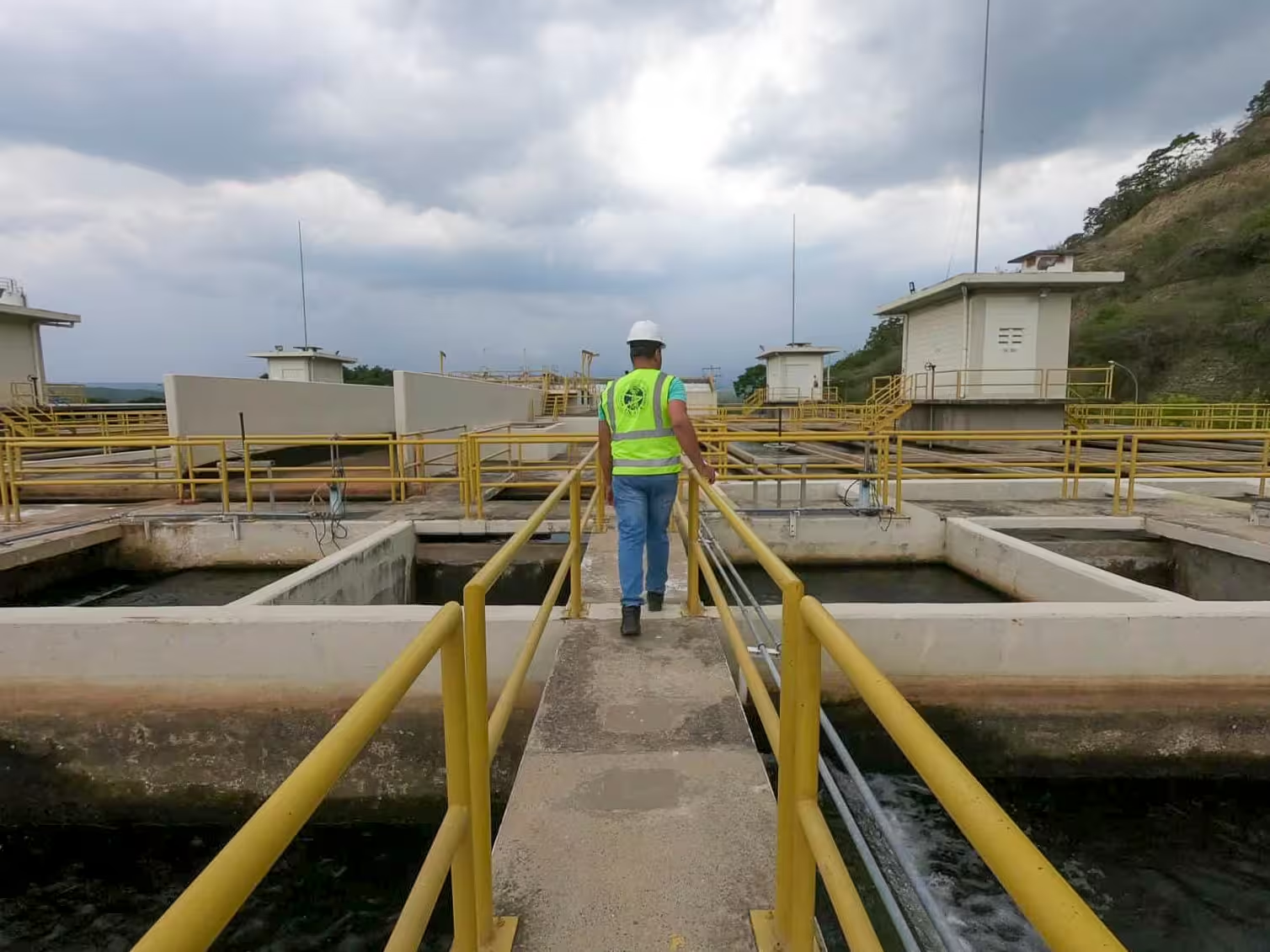
Capacity Building for Water and Wastewater Operators in the Dominican Republic
Watura, in partnership with INAPA (Instituto Nacional de Aguas Potables y Alcantarillados, National Institute of Drinking Water and Sewerage) and funded by the French Development Agency (AFD), is implementing a capacity building program in the Dominican Republic to strengthen the skills of water and wastewater operators, combining field-based training and digital learning to improve utility performance and service resilience.

Addressing the Water Workforce Crisis with Microlearning and Adaptive Training for Operators
The water and wastewater industry is facing a unique challenge: a rapidly retiring workforce, the "Grey Tsunami", combined with accelerating training demands due to new regulations (PFAS, Reuse, Cybersecurity) and evolving technologies.